Adieu “Grey Market”: Indiana & California Lead 2026 Regulatory Blitz Actions

Content Manager
Last updated
29 January 2026


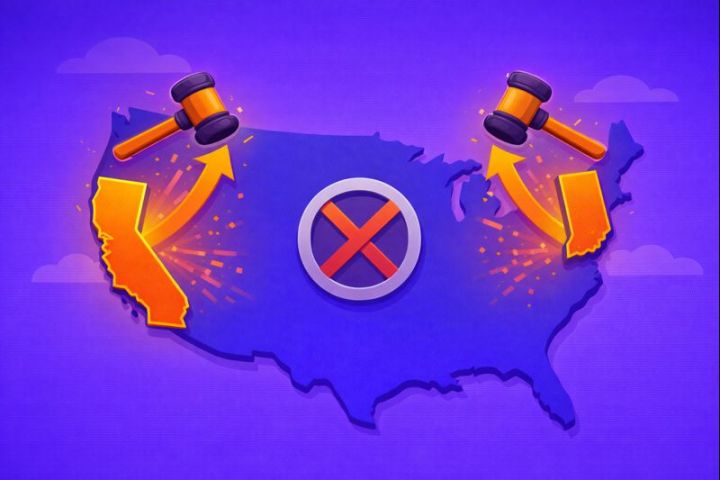
The long-running wait-and-see approach to US sweepstakes casinos appears to be coming to an end. After California fully enforced its regulations on January 1, 2026, regulators in several other states appear to be moving in the same direction.
Taken together, the last few weeks suggest the dual currency social casino model is no longer being treated as a regulatory edge case.
Meanwhile, more and more states are beginning to recognize this matter as one that calls for timely resolution.
Indiana Brings the “Kill Bill” (HB 1052)
While the industry’s focus has recently been on the West Coast, Indiana legislators have been addressing this issue independently. The result is House Bill 1052, which was introduced by Representative Ethan Manning for the 2026 legislative session.
Unlike previous attempts at regulation, HB 1052 explicitly bans the operation of sweepstakes casinos completely. Recognizing that sweepstakes casinos are a form of gambling, the bill reclassifies “virtual currency” that can be exchanged for prizes as “gambling,” even if entry was initially “free.”
The bill also carries a civil penalty of up to $100,000 per violation, though this is arguably secondary to the scope of the bill. HB 1052 explicitly extends liability to the industry’s support structures.
- Payment Processors: Visa, Mastercard, and other financial gateways could start facing enforcement action for carrying out payment transactions.
- Marketing Affiliates: Any media partners or influencers promoting these platforms could face the same penalties as the operators.
Given the legal issues that fueled the growth of “no purchase necessary” models, this wording seems like the perfect solution.
So, what Indiana basically is doing here is addressing the gray market head-on by focusing on money and marketing. The strategy seems clear: to address the gray market directly, rather than simply handing out fines.
Southern Pressure: Enforcement Over Legislation
The sunny South shows that business can be done differently. Rather than waiting for new laws, the authorities of certain states decided it was better to “weaponize” existing laws instead of sitting around waiting for new ones.
The state of Tennessee was one of them that started cracking down on sweepstakes sites earlier this year. Things only took until the end of January 2026 for Tennessee to officially become a hostile environment for sweepstakes sites.
This change occurred after the Tennessee Sports Wagering Council (TSWC) had pressured the Attorney General’s office to issue more cease-and-desist letters to unlicensed online platforms. Of course, none of the existing sweepstakes casinos actually have an official license, which is a major difference from a real gambling establishment.
While officials let us know that there aren’t any new bans on the table, the state argues that none are necessary because existing gambling laws cover these dual-currency models. This leaves operators with a limited set of options: withdraw from the state or prepare for potential criminal charges.
Meanwhile, the state of Mississippi has opened a new legislative front. In mid-January, legislators introduced Senate bills that are essentially identical to California’s framework. Although still in the early committee stage, the “California Model” of a total statutory ban is spreading to conservative Southern states.
California: The Post-Ban Reality (AB 831)
The state of California is probably the best example of how the industry is changing in both forward and potentially vertical directions.
California’s infamous Assembly Bill 831 took effect on January 1, 2026. The bill aims to clarify the state’s longstanding treatment of the gray market. Due to the potential criminal penalties, which could include jail time and fines of up to $25,000 per violation, big platforms such as Stake.us, Pulsz, and High 5 quickly began blocking California IP addresses.
Now, here’s why things could shift in another (vertical) direction: It could be that the whole sweepstakes situation might not be settled just yet. Players within the industry are now keeping a close eye on developments due to the prospect of retroactive liability.
Key players in the discussion include the San Manuel Band of Mission Indians and representatives from several other tribal nations. They are now examining the profits these companies earned before the ban and wondering if legal action will be taken or if it will simply make it more difficult for these companies to do business in California.
🔗 References & Official Filings
Indiana General Assembly (2026 Session)
- Legislation: House Bill 1052 (Sweepstakes Ban) & House Bill 1432 (iGaming Legalization)
- Sponsor: Rep. Ethan Manning (R)
- Status: Introduced; Committee on Public Policy.
Mississippi Legislature
- Legislation: Senate Bill 2104 (Online Sweepstakes Regulation)
- Filing Date: January 13, 2026.
California State Legislature
- Statutes: Assembly Bill 831 (AB 831)
- Effective Date: January 1, 2026.
Tennessee Attorney General
- Enforcement: Three More Illegal Sports Gaming Entities Stop Operations In Tennessee
- Date: October 23, 2025.