If you’re in Iowa, you can still play, but put on the clock. A new bill hands the IRGC cease-and-desist authority on July 1, with no operators in the crosshairs yet. The lights don’t automatically go out that day; but the regulator does get a switch. As for now, your signups and redemptions clear normally.
Our page covers our top picks for Iowa players, what we recommend you do with your balance, and which operators already left.
Sweepcasinos Choice

1.3M CC + Free 65 SC – 170% More on First Purchase
Welcome bonus
200,000 GC + 20 Spins
Welcome bonus
25,000 GC + 2.5 SC
Welcome bonus
200,000 GC + 100 FC
Welcome bonus
50,000 GC + 1 SC
Welcome bonus
50,000 GC + 1 SC
Welcome bonus
120% Welcome Purchase Offer + 68 Free SC
Welcome bonus
100,000 GC + 2.5 SC
Welcome bonus
200% + $20 First Purchase Bonus
Every site on this list passed our cashout, free entry, and deposit-pressure checks. The rest didn’t make it.
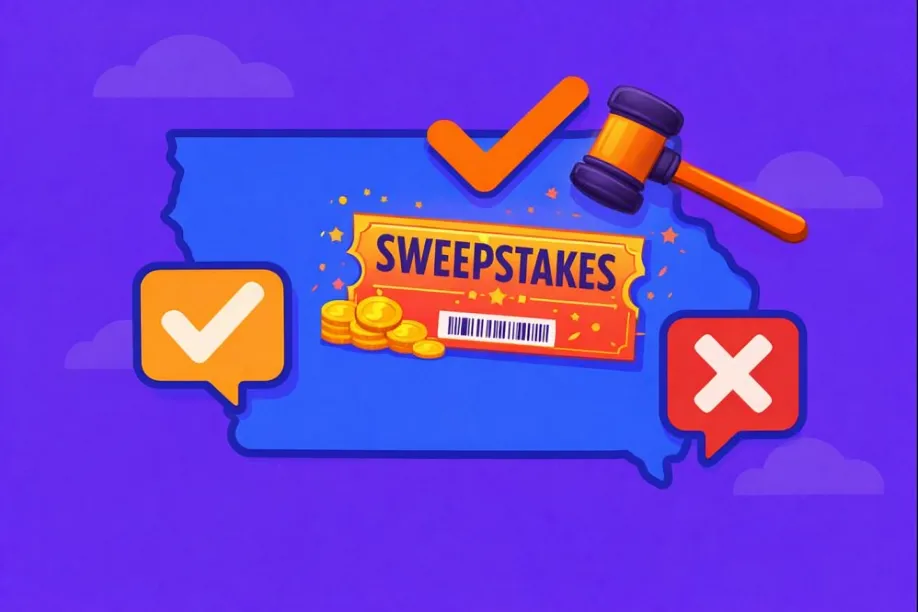
How We RateIowa took a middle path on sweepstakes casinos. Middle, because the state didn’t pass a direct ban, but still took action. Governor Kim Reynolds signed SF 2289 on May 15, 2026, giving the Iowa Racing and Gaming Commission (IRGC) the power to issue cease-and-desist orders to operators. The law takes effect July 1, 2026.
But until then, you can still play sweepstakes casinos from within Iowa, with most major brands accepting your signup. Just be aware that, after July 1, the IRGC will have the authority to push operators out, although it hasn’t named specific targets yet.
Below, we walk through the law and what’s left for you before and after July 1.
| Are sweepstakes casinos illegal in Iowa? | No, but enforcement is coming. SF 2289 doesn’t ban sweepstakes by name. It gives the IRGC the power to issue cease-and-desist orders, effective July 1, 2026. |
| What does the law actually do? | SF 2289 amends Iowa Code Chapter 99 to grant the IRGC cease-and-desist authority and the power to seek court injunctions against unlicensed gambling operators (including sweepstakes platforms). |
| Who enforces it? | The Iowa Racing and Gaming Commission (IRGC), led by Director Tina Eck. |
| Why didn’t Iowa pass a direct ban? | Iowa chose to arm its regulator with enforcement tools rather than legislate a direct ban. This is similar to Kentucky’s approach: no statutory ban, but aggressive regulatory action. |
| Has the IRGC named which operators it will target? | No. As of May 2026, the IRGC hadn’t publicly named any specific operators as enforcement targets. |
| What happens after July 1, 2026? | The IRGC can send cease-and-desist letters and seek court injunctions. Operators have to choose: comply, exit Iowa, or litigate. |
| What can I legally play in Iowa? | 19 commercial casinos (riverboat and land-based), tribal casinos, online and retail sports betting (since 2019), the Iowa Lottery, and parimutuel horse racing. |
| Can I sign up to a sweepstakes site in Iowa right now? | Yes. Until at least July 1, 2026, most major brands accept Iowa players. |
| Will I get in trouble as a player if I continue to play? | No. SF 2289 targets operators, not individual players. The IRGC’s enforcement authority applies to anyone providing unlicensed gambling activity. |
| Could the sites I use leave Iowa suddenly? | Yes. If the IRGC issues cease-and-desist orders after July 1, operators may comply quickly (like in New York and Tennessee) or ignore them (like in Illinois). Either way, your account access could change in weeks. |
| What should I do with my balance? | Consider cashing out. Sweeps Coin balances should be redeemed before July 1, 2026, in case the IRGC moves quickly and operators wind down without warning. |
| Will a VPN help if operators leave? | No. Sites verify your location at every login and close accounts that try to mask it. |
| Do I owe taxes on winnings? | Yes, federal and state. Tax law treats sweepstakes winnings as taxable income. Report filed on Schedule 1; Iowa taxes them at the state’s 3.8% flat income tax rate (2026). |
Compare Iowa’s stance on sweepstakes casinos to those of bordering U.S. states.
Because enforcement power is faster and more flexible than a ban. A statutory ban is rigid and invites a court fight over its wording. SF 2289 instead lets the IRGC act case by case, with cease and desist orders and injunctions from July 1, 2026. That mirrors Kentucky, which pressured operators out without ever passing a ban.
It’s less predictable, and that’s the trade-off. A flat ban hands you a fixed date to plan around. Iran’s model instead leaves the IRGC free to act whenever it chooses after July 1, 2026. So, your access could end next month or hold for a year, with no schedule to read. For a player, that means treating any Sweeps Coins balance as something to redeem now, rather than later.
Yes, because the threat alone does the work. From July 1, 2026, the IRGC can issue cease and desist orders at any moment. As of May 2026, it had named no targets, but operators do not wait to be named. Several already left Iowa, rather than risk the first letter. So, the date matters less for what the IRGC does than for what operators do in anticipation.
It splits three ways, and Iowa will likely see all of them. After July 1, 2026, an operator served with an order can comply, exit the state, or fight in court. Most fold fast, the way brands did in New York and Tennessee in 2025. A few dig in and ignore the orders, as some did in Illinois. So, your access depends less on the law than on which path your site chooses.