If you are trying to figure out why South Dakota sweepstakes casinos feel so damn unpredictable, well, you are not alone. Some platforms still load. Others stop the moment you try to redeem anything. But if you take a good look at the state’s rules, you begin to see why the experience plays out this way.

Now, let us start with the most pressing question here. Are SD sweepstakes casinos even legal.
The answer: No. Sweepstakes casinos are not legal in South Dakota, even though the state never wrote a dedicated “sweepstakes ban.”
What happened here is much simpler. South Dakota already had the necessary gambling laws in place, and once someone had the glorious idea to line up the sweepstakes model with those statutes (more about this a bit further down), the activity fell straight into the category the state has been regulating for decades.
South Dakota never carved out an exception for digital games that end in real-value rewards.. And because the system works on authorizations, not assumptions, anything outside those authorizations automatically happens to sit on the wrong side of the line. Sweepstakes online casino platforms just happened to discover that reality once their model started bumping into the state’s definitions.
Big-name sweeps sites you can’t use in South Dakota
SDCL 22-25-1 doesn’t use fancy language. It simply states that you cannot “engage in gambling in any form” unless another law permits it. When you examine what counts as gambling under that framework, three elements appear every time.
Now, consider how sweepstakes casinos work in light of these elements. You buy a coin package. This purchase unlocks sweepstakes entries. These entries activate games like sweepstakes slots, and the outcomes can be redeemed for cash.
Once you map each step to the statute, it becomes clear why the state never needed a special “sweepstakes” category. The mechanics already satisfy the definition.
Since South Dakota never authorized online, casino-style gaming anywhere else in the code, the entire setup is illegal without the need for new legislation.
South Dakota has been addressing online gambling long before sweepstakes casinos started appearing. Back in 2000, the state instituted SDCL 22-25A-7 and 22-25A-8. And these two statues work together.
These statutes focus on how the gambling activity functions. If a platform accepts your paid entries through an online system and provides prize outcomes in the same manner, South Dakota considers the entire transaction to be an internet wager.
Since this type of activity has been illegal since 2000, sweepstakes casinos fall under an existing legal framework.

The state is not tailoring penalties to the sweepstakes model. It is using the same set of tools it uses for unlicensed gambling in general. The sweepstakes format just happens to fit the definition neatly enough that the existing machinery snaps into place, without requiring a new rulebook.
For a pretty long time, South Dakota officials kind of kept us in the dark. The whole thing was pretty vague about how they felt about sweepstakes casinos being legal or not.
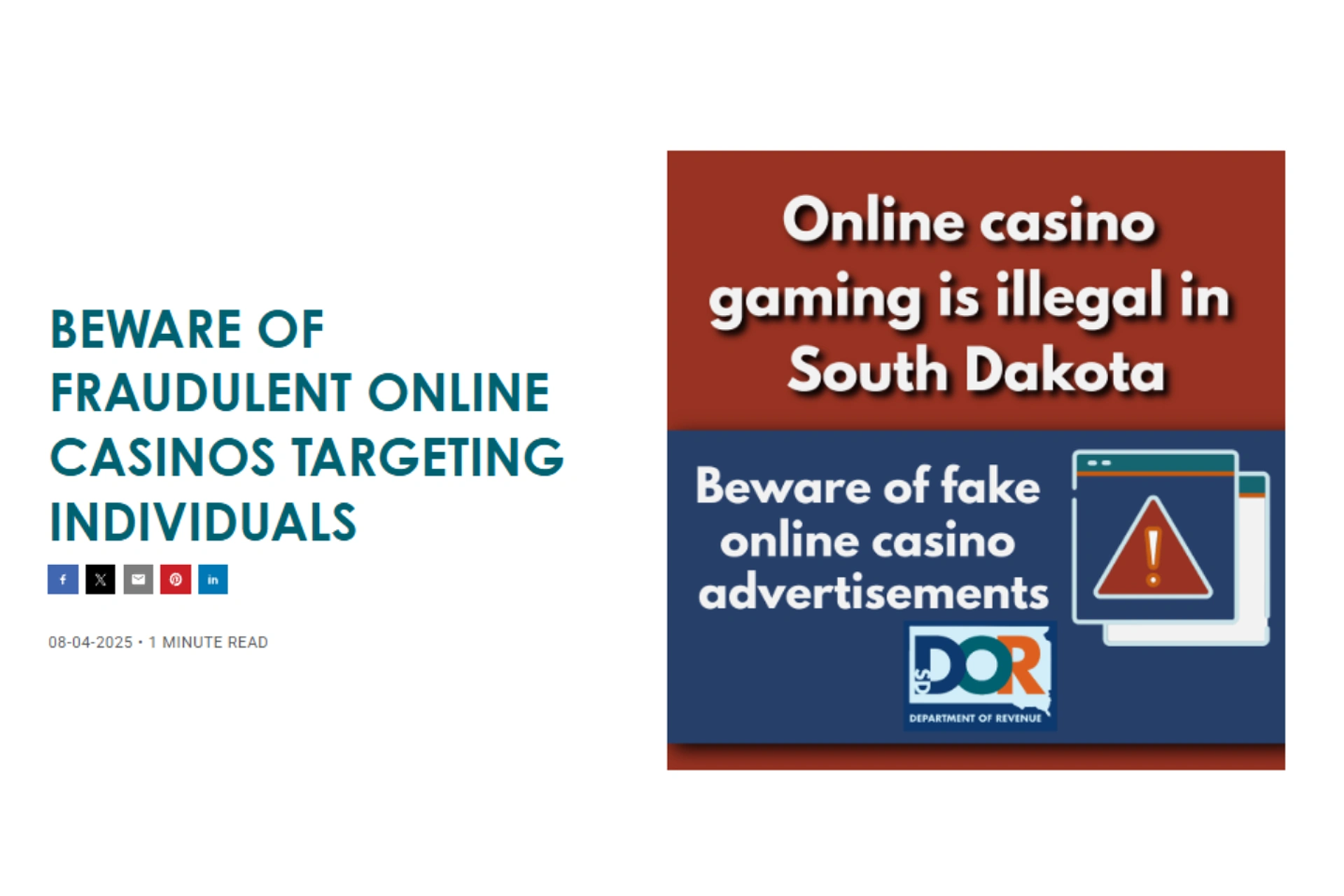
That silence lasted until August 2025, when the South Dakota Gaming Commission published a statewide alert. In that alert, the Commission suddenly followed a very easy-to-understand approach:
Online casino gaming is not legal in South Dakota. (South Dakota Commission on Gaming, 2025 PSA)
Once that sentence came out in an official notice, the discussion about sweepstakes casinos in South Dakota stopped being up in the air. The regulators put the pieces together that we all had been trying to figure out on our own.
In the next section, we’ll take a closer look at what they said exactly.


Source: South Dakota Department of Revenue. “Beware of Fraudulent Online Casinos Targeting Individuals.” Published August 4, 2023.
Once the Commission finally said online casino gaming is not legal in South Dakota, the next logical question is to ask what exactly falls inside that statement.
And this is where the alert goes from being a simple heads-up to being a roadmap for how the state reads sweepstakes-style play today.
If you look at the release, you’ll see that the Commission is doing two things at once. First, it lets people know about fake sites that look like licensed Deadwood casinos. Second, and far more important for you, it spells out which activities are considered illegal under South Dakota law. They don’t list every platform by name, rather, they outline the kind of behavior that could get a site in legal trouble.
This is the part you usually want a straight and very quick answer to, so let us address it just as plainly as the alert implies:
The PSA sends you a warning not because they are preparing to charge you with a crime, but because they want to make it clear that you have no protection if you play on a SD sweepstakes site. In other words: Your risk is practical, not criminally related. So, in the event that a sweepstakes casino freezes your account, ignores your redemption request, or disappears overnight, the state can and will not help you out.
The state considers a sweepstakes casino that accepts paid entries from within South Dakota to be a gambling business conducting online wagering. According to SDCL 22-25A-7 and 22-25A-8, this is illegal. The operator is “accepting,” “conducting,” and running a system that the state has not authorized.
And once a company crosses that line, several things can follow:
The state can cut their access: The first sign is usually that the operator loses its South Dakota audience for no apparent reason. Traffic drops. Login attempts stop. Pages fail to load. None of this comes with an announcement because the state does not need one. A quiet geoblock does the job, leaving the operator to guess which switch got flipped.
Sweepstakes casinos and social casinos look very similar at first, but once you apply South Dakota’s legal framework, the differences stand out.
If you refer to SDCL 22-25-1, you will see that the state’s definition of gambling always requires three things.
As a matter of fact, online social casinos break the chain at the last step. You can play. You can buy tokens if you want. However, nothing you win has value outside the game.
So, if you stick to playing at social casinos:
In short, social casinos have no red flags because they have no payouts.
Compare South Dakota sweepstakes rules and top sites to those of bordering states.
No, because when you align the sweepstakes model with SDCL 22-25-1 (the gambling definition) and SDCL 22-25A (the online gambling statutes), the state considers it to be an unauthorized gambling operation. The 2025 Commission alert simply made this interpretation public. You can still access some platforms because the operators block access, not you. However, accessing these platforms does not mean the state approves of the activity.
No, South Dakota directs its enforcement efforts toward businesses, not individuals trying out sweepstakes games. The statutes that carry penalties target those who run or facilitate illegal gambling, not those who play on a site that is still operational. Your risk is practical, not criminal.
No. There is nothing in the 2025 alert that suggests the state is watching individual players. Their eyes are on the companies, not on you. If they ever intended to track users, they would have said so out loud.
The operator decides that, not the state. The sign-up process does not reflect South Dakota law. They reflect how much legal risk the company is willing to tolerate at the moment. Some companies have already removed popular features. Others are pretending that nothing is happening. None of this changes the state’s actual position.
Yes, there are actually penalties here. Operating an unauthorized gambling business violates SDCL 22-25-1; accepting online bets violates SDCL 22-25A-7; and running an online gambling system violates SDCL 22-25A-8. Companies retreat the moment regulators show interest because these violations can result in fines, charges, and removal from the state.
Yes, and it happens pretty often. When a company sees legal exposure, it either removes key features or closes the door entirely. It’s not like you’re being punished or anything. The operator is trying to avoid becoming the next name in a state file. Expect changes to access to happen without warning.