Why a VPN backfires when your state is blocked
A good VPN can get you into a blocked sweepstakes casino, but it won’t get you past the cashout ID check. That’s the one that’ll get you kicked off the platform. This guide will walk you through the three most important location checks, explain why one flag can void your balance, and point you towards greener pastures.

Content Writer
Last updated
19 June 2026

The so-called “fix” explained
The logic feels airtight, which is exactly why so many of us fall for it. Your state blocks sweepstakes play, the site throws up a location error, and a virtual private network, or VPN, looks like the one switch that makes the problem disappear.
If you have not used one, a VPN reroutes your internet connection through a server somewhere else, so a site sees that server’s location instead of where you really are.
I flipped that switch once, back when I knew less than I do now, and it went about as well as you would expect, which is to say, it cost me. The reason it cost me is worth understanding before you reach for the same switch.
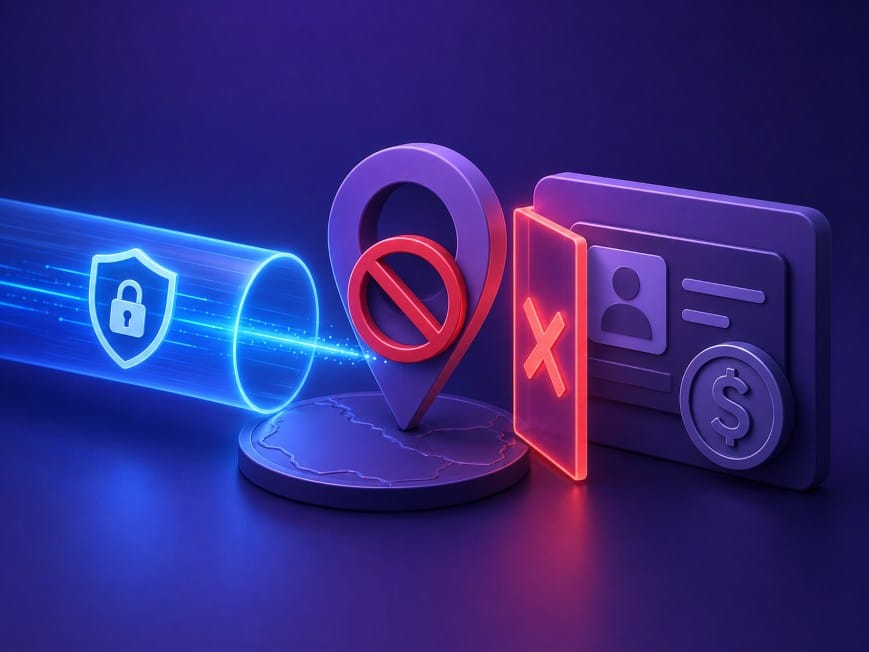
A sweepstakes casino does not read your location once, at the door. It checks across three separate layers that get harder to fool as you go, and a VPN only ever reaches the first of them. Clear that one with a good enough VPN, and the other two are still standing there waiting.
People worry way too much about getting in. Because it’ll always be the final stage, like getting paid, that you won’t make it through.
The 3 location checks a VPN would have to beat
Here they are, in the order you would run into them.
The doorway: your IP
The first layer reads your IP address. It is the only one a VPN can even reach, which is why everyone pins their biggest hopes on it.
The trouble is that cheap and free VPNs alike route you through data center servers, and those addresses sit on public blocklists that operators and their fraud tools check on sight. So, instead of looking like a home in an allowed state, your connection looks like a VPN, which is a giveaway on its own. Proxies and DNS workarounds get flagged the same way.
More often than not, you do not slip past this door, as much as bang on it.
The device: GPS, WiFi, and cell signal
Clear that doorway with a cleaner address, and you have solved exactly one of the three layers, because on a phone, your IP is only one signal among many. The app can also read your GPS, the WiFi networks within range, and the cell towers your phone is talking to, then check all of it against the IP you just faked. A VPN changes none of those other signals.
So, it produces the most common giveaway there is: an IP placing you in Texas while your phone places you in New York. The location services that specialize in this run hundreds of checks on a single connection, hunting for exactly that contradiction, plus fake GPS apps, edited coordinates, and jailbroken phones.
Clearing the doorway, then, gets you exactly as far as the next layer, and no further.
The final wall: the cashout ID check
Clear the device layer, too, somehow, and play for weeks, which is roughly as far as I got before reality arrived. You still reach the layer no VPN has ever touched because it has nothing to do with your internet connection.
Before a sweepstakes casino releases a single Sweeps Coin, it makes you prove who you are: a government ID, a selfie, and a proof of address document, all checked by providers whose whole job is catching a fake. Your ID has to show an allowed state, and your proof of address has to match it. A VPN, for all it can do, cannot forge a driver’s license.
So, the balance you spent those weeks building freezes the instant you ask to withdraw it, at the one moment it finally mattered. Cruel, and entirely predictable.
Why faking your location will be a losing bet
A location flag is not a minor penalty. Here is the full size of what it takes.
One flag takes the whole account, not just the payout.
Masking your location breaks the rules you agreed to at signup, so a flag does not just stall the payout, it usually takes the whole account with it: suspended or closed, balance and winnings voided, often a ban that follows you to the operator’s sister brands. Whatever you spent on Gold Coins along the way tends to go, too.
None of it can be appealed. By playing from a blocked state, you were never eligible to win in the first place, so the money you are mourning was never actually yours.
A VPN is the excuse operators look for.
Operators do not enjoy voiding a winner because nothing scares off new players like a reputation for not paying. So, what they look for instead is a rule you broke, any rule, that lets them void you cleanly, and a VPN is the easiest one you could possibly give them.
Play within the rules, and a big win is usually safe. Use a VPN, and you have written their excuse in your own handwriting.
A free VPN hides nothing and sells your data on top.
If the rule you break is wrapped in a free VPN, it fails sooner and costs you more.
Free services crowd onto the same flagged data center addresses, so they fail at the doorway fastest of all, and many leak your real location through DNS, regardless, which means they do not even hide the one thing you installed them to hide.
Worse, a free VPN usually pays for itself by selling your data, and your data here is your ID, your home address, and your card details. That is a steep price for a workaround that was never going to work.
What the case against a VPN leaves out
A whole guide spent steering you away from VPNs can leave two wrong impressions. Here are both set straight.
You can get blocked without cheating
The same checks catch people who never tried to beat them.
You can live in a fully legal state and still get shut out the moment you step into a blocked one, even for an afternoon, because eligibility follows where you are physically standing, not where you live. Near a state border, it gets less reliable still, since your phone’s GPS can drift across the line on its own and trip the block while you sit on your own couch.
Reaching for a VPN here only makes you look like the spoofers above. The fix is the opposite: Keep WiFi switched on, because WiFi positioning is more accurate than cell signal alone, and do not play while you are physically inside a blocked state.
The VPN is not the villain
The tool itself is not the problem.
For everyday privacy, for securing your connection on public WiFi, for keeping your browsing to yourself, a reputable VPN earns its place on your devices. The single move that burns you is pointing it at a sweepstakes casino to fake where you live.
Same tool, opposite result. Use it to protect yourself, not to pretend you are somewhere you are not.
Where to play when your state is blocked
So, skip the VPN. The move here is not a better workaround; it is a different plan.
Play a social only casino instead. These run on a single currency, with nothing to redeem for cash, which keeps them legal in all fifty states, so you keep the games and give up only the prizes. That still beats giving up both.
Watch the law, not the workaround. State rules are changing almost right now, so the brand blocked today may reopen tomorrow, or a new one may launch in your state.
If you are only traveling through a blocked state, wait. The games will still be there when you are home, on your own connection, with WiFi on.
This guide provides general information and is not legal advice. Sweepstakes rules and state laws differ and are changing quickly, and in some places, playing from a blocked state can carry its own legal risk, so check your own state before you play. If a significant balance is involved, talk to an attorney licensed in your state.