How to read sweepstakes casino terms (without falling asleep)

Content Writer
Last updated
19 June 2026

What you get from this guide
- The 7 things to check on any sweepstakes site’s terms before you sign up, in the exact same order I check them.
- A real example of each check, done right and done wrong, so you can spot the same forfeiture clause, fake AMOE, or hidden cap the second you see it on another site.
- Two ways to run the skim: my 10 minute manual walkthrough, or paste the terms into ChatGPT with the 12 questions at the bottom of this guide, and get the same result in 1 minute.
- The limits of what the terms can do for you, plus the Trustpilot check I run before I trust any site with my time.
Why I wrote this guide
Back in 2022, I had about $400 worth of Sweeps Tokens sitting in my Galaxy Fortunes account when the site announced it was shutting down. They gave everyone two weeks’ notice and refunded the Game Tokens players had bought with cash. Fair enough. Except, Section 13 of their terms (a clause I’d never bothered reading) wiped out every Sweeps Token I’d earned through play. Sweeps Tokens were the redeemable kind. The whole reason my balance meant anything. Gone on closure day.
Every sweepstakes casino makes you tick a box agreeing to a long legal document when you sign up, but nobody actually reads it. It’s tucked at the bottom of the homepage, usually called Terms of Service or Sweepstakes Rules. That document decides who’s allowed to play, how cashouts work, when your account can get yanked, what happens if the site goes under, and how disputes get handled.
All of the flashy stuff up front (the homepage, the bonus banners, the “How It Works” walkthroughs, the welcome email) won’t breathe a word about any of it.
My big, fat advice: Read the document before you check the box. It stops being their word against yours, and starts being their published terms against yours. Much better place to argue from.
The 7 checks I run before I sing anywhere
These are the 7 questions I answer before I trust a sweepstakes site or social casino with my email, my ID, or a single dollar. I open two tabs, the Terms of Service and the Sweepstakes Rules, and walk through them in order.
If a site fails any one of these checks, I close the tab and play somewhere else.
Check 1: Who runs this site?
A legitimate operator names four things inside the first paragraph of its terms: the company name, the registration number (the ID a country gives a registered business), the country, and the street address.
If any one of those is missing, you have nobody to file a claim against if a payment goes missing, and a balance you can’t collect on isn’t really a balance. Missing operator details are the single biggest tell that a site is fake rather than just badly run, which our team covers in How to Spot a Fake Sweepstakes Casino.
✅ Good: LoneStar Casino
Clause 3.2 of LoneStar‘s terms names REALPLAY TECH INC. as the operator and Realplay Ltd. as the software supplier. Two named entities, both verifiable in corporate records, before I deposit a cent.
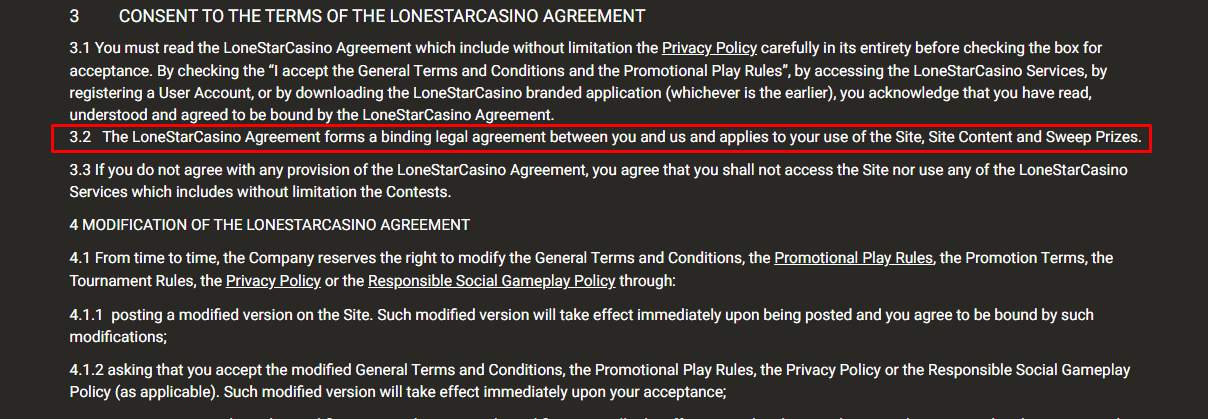
Source: Screenshot of LoneStarCasino Terms, Clause 3.2, showing the binding agreement between users and the company. (Lonestarcasino.com)
❌ Bad: VBlink
VBlink Casino calls itself ‘The Company’ and ‘Us’ throughout the entire document. No name. No registration number. No address. Then they drop a line saying the agreement is governed by “prevailing laws of Netherlands”, even though they market the site to US players.
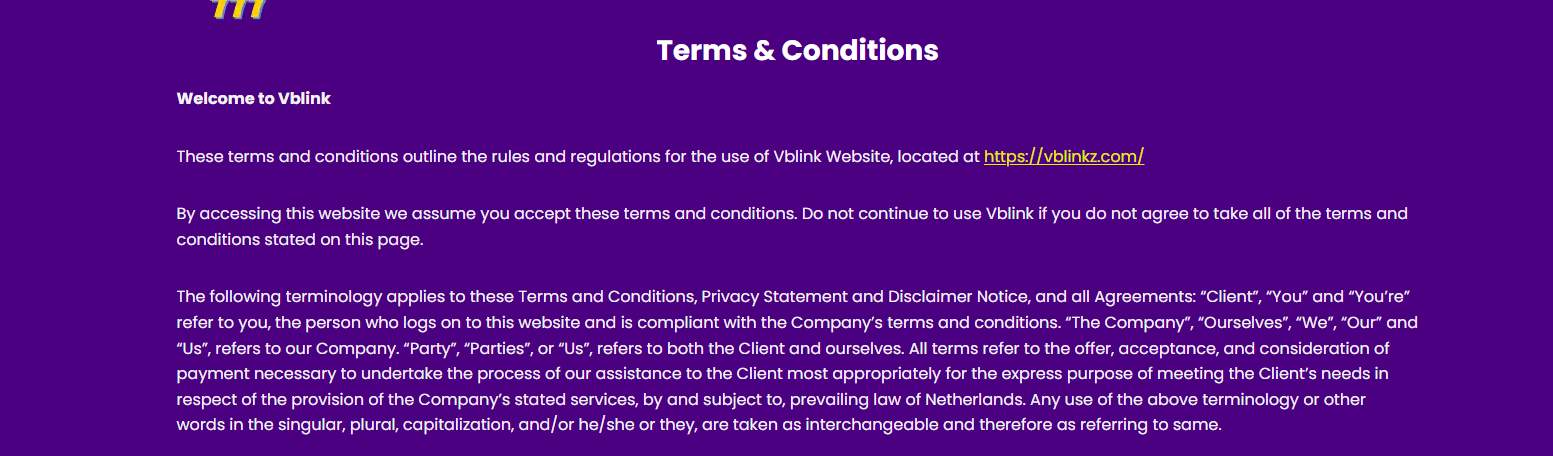
Source: Screenshot of Vblink Terms & Conditions page, showing the site’s acceptance terms and company terminology. (Vblinkz.com)
Check 2: Is your state on the restricted list?
Sweepstakes casino legality varies state by state, and can change on a daily basis, so I want every excluded state spelled out plainly near the top of the document.
What I don’t want is a vague “Void where prohibited,” which is legalese for “We’ll decide later if you were eligible.” That decision usually happens after you’ve already won, which is the worst possible time to find out you weren’t.
✅ Good: RealPrize
RealPrize Casino lists every excluded state on the homepage, not buried inside the Terms of Service or Sweepstakes Rules. Most operators put this list halfway through the Rules document, which means you only see it after you’ve signed up.
The exclusion list runs through New York, New Jersey, Arizona, California, Connecticut, Delaware, Louisiana, Maryland, Idaho, Michigan, Nevada, Montana, Washington, Texas, and West Virginia.
They also ban VPN and proxy use (tools that hide your real location), and getting caught means account closure. That ban protects you as much as it protects them. Sign up from an excluded state through a VPN, and the site’s location software will eventually catch the mismatch between your VPN address and your real one, usually at cashout when your bank or ID address doesn’t match, and the operator voids the redemption.
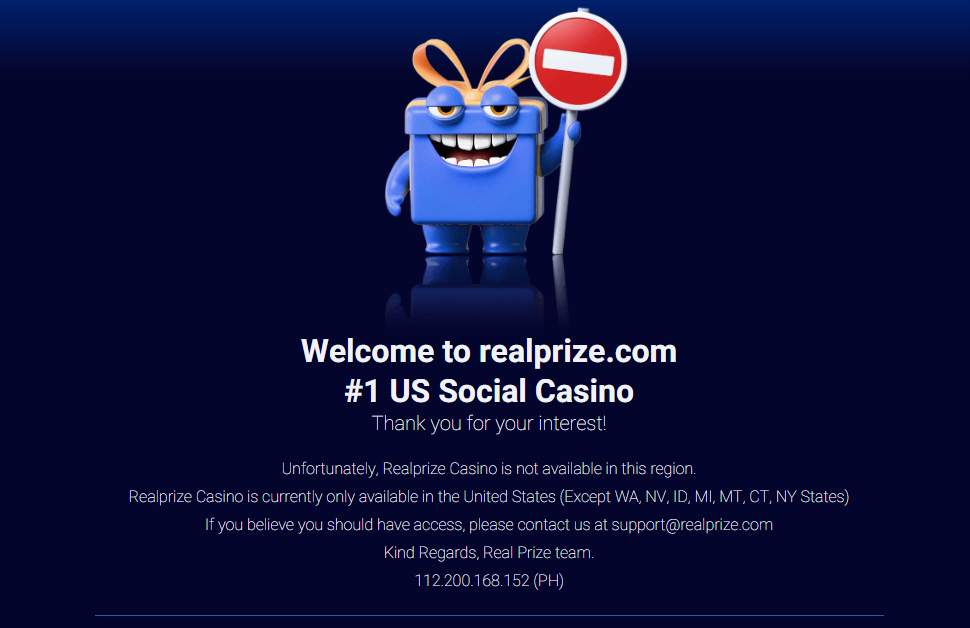
Source: Screenshot of RealPrize regional availability notice, showing access restrictions, excluded US states, and support contact. (Realprize.com)
❌ Bad: Panda Master
PandaMaster gives me one eligibility line in Section 2: I must be 21 or older. That single line is the entire eligibility framework. No state list. No jurisdiction map.
The next clause tells me I have to ‘abide by all laws applicable in your place of residence,’ which shifts the entire compliance burden onto me and reserves the operator’s right to disqualify me later if I happen to live somewhere they decide is prohibited. Cool, very helpful.

Source: Screenshot of PandaMaster eligibility terms, showing the 21+ age requirement and access restrictions for underage users. (Pandamaster.com)
Check 3: How does the coin system work, and can you mail in for free coins?
The coin system decides whether the site is running a legal sweepstakes or a paid lottery, so I read it more carefully than any other section. I’m looking for two things. First, two coin types.
One you play with for fun (usually called Gold Coins or GC). One you can redeem for real prizes (usually called Sweeps Coins, or SC).
The redeemable one must never be sold for cash, only earned. Second, a free postal entry option, often called AMOE (Alternative Method of Entry, a fancy name for “mail us a postcard and we send you free Sweeps Coins”).
If the redeemable coins are gated behind a purchase, the site is running a paid lottery dressed up as a sweepstake, and the prizes aren’t legally enforceable. ‘Not legally enforceable’ means you can’t sue them if they don’t pay.
✅ Good: Spree
Spree Casino spells it out plainly: Gold Coins can be bought or earned for free. Spree Coins (the redeemable kind) can never be purchased, and only enter your account through gameplay, bonuses, or the postal route.
The mail in route is in Section 3.2.10 of the Sweepstakes Rules. You generate a unique 13 digit request code, write a specific phrase on a card (‘I would like to request free Spree Coins offered by Spree Services Ltd in order to enter the promotional Sweepstakes offered on spree.com’), and mail it. You get 4 SC at a 1x playthrough, which means you wager the 4 SC once before you can cash it out.
I’ve actually emailed one. The 4 SC arrived three weeks later. Slowly, but the postal route works as written, which means the AMOE is a real compliance mechanism the operator honors, rather than a clause that exists only to satisfy lawyers.
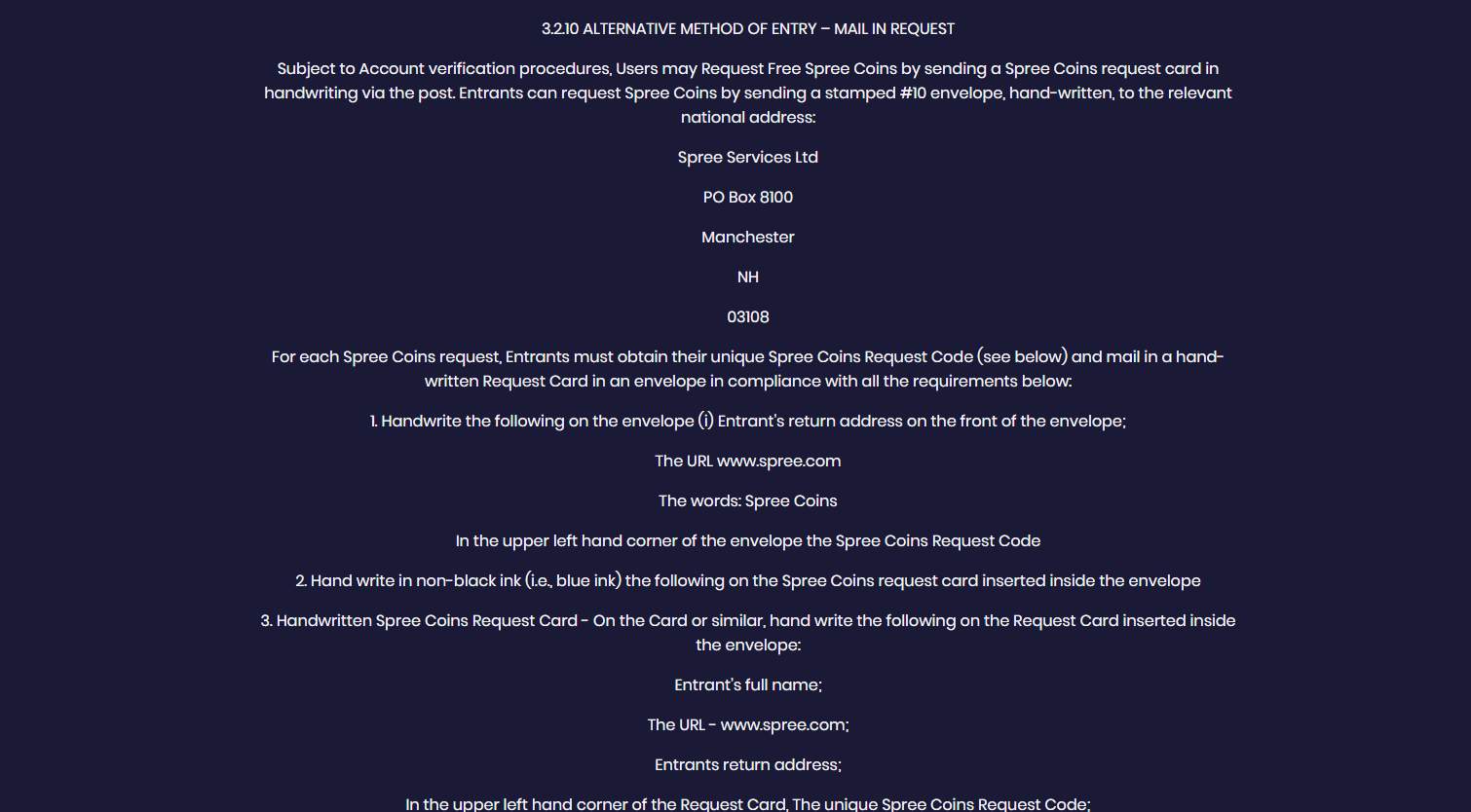
Source: Screenshot of Spree’s mail-in request terms, showing the alternative entry method and handwritten request requirements. (Spree.com)
❌ Bad: Ace Reveal
Ace Reveal Casino pretends to be a sweepstakes site, and is actually a phone card shop with a casino bolted on. I figured this out 30 seconds in when I read that $1 buys 100 sweepstakes points, alongside 10 minutes of US calling.
There is no separate AMOE on Acereveal. No postal route. No statement that points can be obtained without buying the phone card. The redeemable side is gated behind a payment, which is the legal definition of “consideration” (paying something to enter), which is the one thing a sweepstake cannot have.
I would not redeem anything from this site even if I won the entire database.

Source: Screenshot of Ace Reveal Casino “Getting Started” section, showing account setup steps and purchase-based sweepstakes rewards. (Acereveal.com)
Check 4: What are the cashout numbers?
Three numbers decide whether you can ever actually cash out: the minimum redemption (how many SC you need to pull), the playthrough multiplier on free SC (how many times you have to wager before the SC is yours, usually 1x at legitimate sites), and the daily or weekly cap (the most you can pull in one day or week).
All three numbers belong in the contract, not in marketing copy. If they’re missing, the operator gets to invent them later, and “later” usually means “after you’ve built a balance worth taking.” That is exactly when payouts get stuck, which is the moment my guide on How to Fix a Stuck Redemption becomes useful.
✅ Good: PlayFame
All four numbers are published on PlayFame‘s redemption page. Sweepstakes casino gift card cashouts at 10 SC. Bank transfer cashouts at 75 SC. Daily cap of 10,000 SC for most states, dropping to 5,000 SC if you live in Florida or New York. And a 1x playthrough on bonus SC.
I tested this myself with the Welcome 2.5 SC. Met the 1x playthrough in about 20 minutes of slot play, redeemed for a $10 gift card, got it the next day. The numbers, hero.
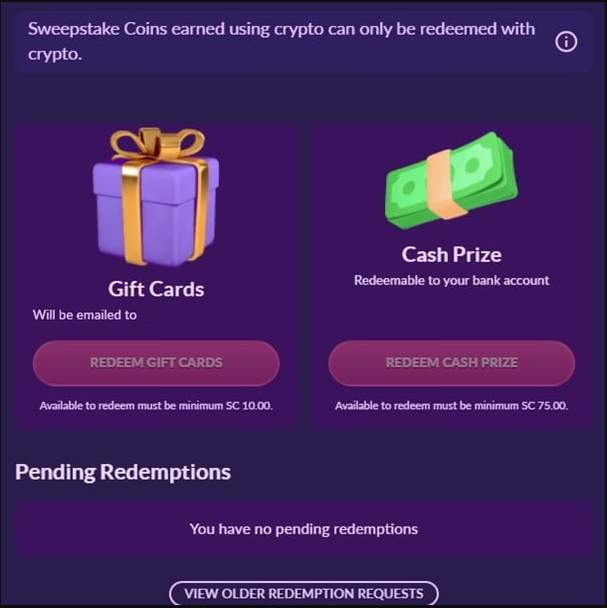
Source: Screenshot of PlayFame redemption page, showing gift card and cash prize redemption options, minimum redemption amounts, and pending redemptions. (Playfame.com)
❌ Bad: Firekirin
Firekirin is one of those clowns that doesn’t even bother to publish a Terms of Service page. I checked the footer twice, just to make sure they hadn’t hidden it behind a clever icon. Nope.
No contract means no written promise to pay you, no procedure to challenge a non payment, and no jurisdiction to file the challenge in even if you fancied a long afternoon trying. The operator is telling you, by omission, that the answer to “what happens when something goes wrong” is “we decide, you accept it, have a nice day.”
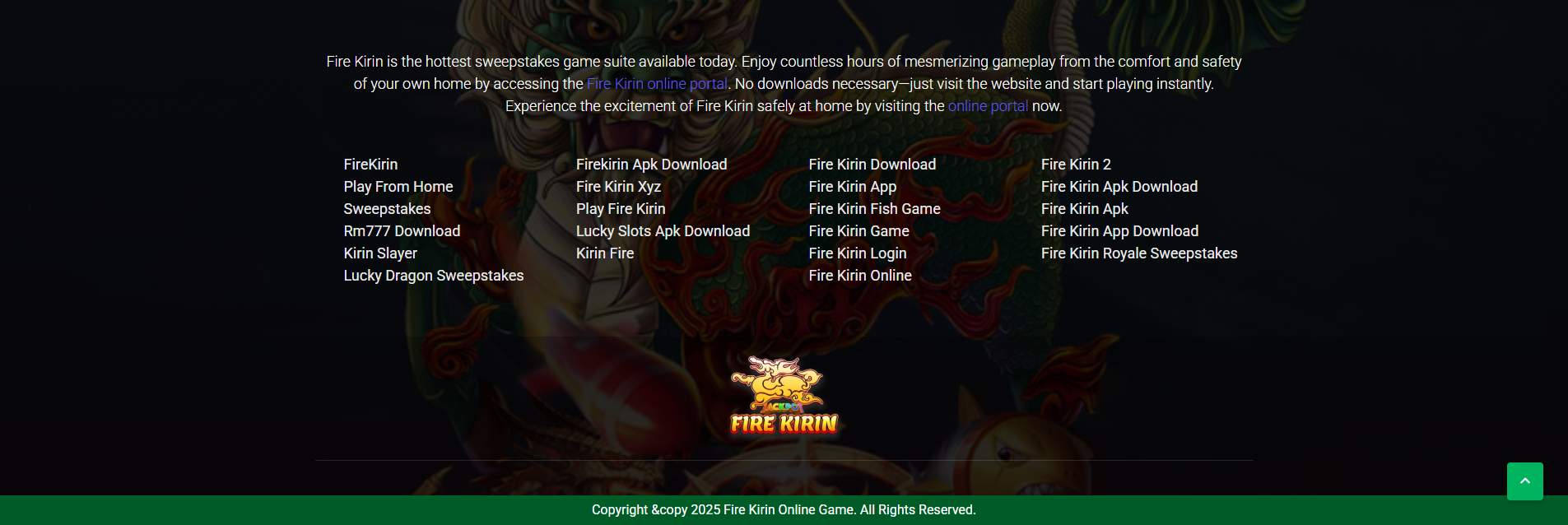
Source: Screenshot of Fire Kirin portal footer showing game links and copyright notice, with no visible Terms & Conditions link. (Firekirin.com)
Check 5: When can they take your balance away?
Every operator reserves the right to lock your account and wipe your balance. In the terms, it’s usually called the “forfeiture clause,” “account suspension clause,” or filed under “fraud and abuse.” That clause is normal, so I’m not looking for the absence of it. I’m looking for whether the trigger is specific or vague.
Specific triggers are things like chargebacks (telling your bank to reverse a card payment after you already made it), opening multiple accounts, or identity fraud. Specific is fine. Vague triggers (clauses that let the operator decide what counts) are the ones that turn a winning balance into a closed account.
✅ Good: Fortune Wins
Fortune Wins reserves the right to block accounts “in our sole discretion,” but ties that discretion to defined behaviors: chargebacks, ACH reversals (when you cancel a bank transfer after the fact), and payment fraud. I can read the clause and know which specific actions will get my account closed, which is what a contract is supposed to tell me.
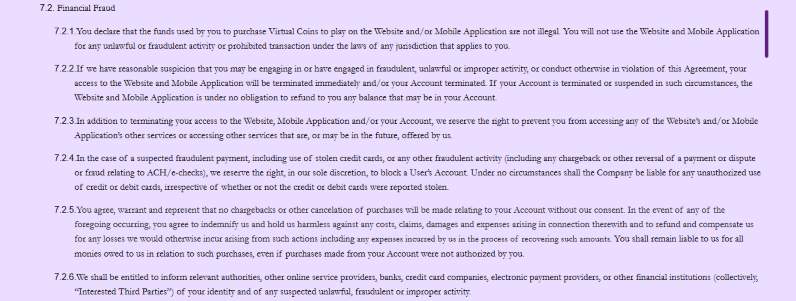
Source: Screenshot of Fortune Wins (formerly Fortune Coins) financial fraud terms, showing restrictions on illegal funds, fraud, chargebacks, and account termination. (Fortunewins.com)
❌ Bad: Bitplay
Section 6.16 of BitPlay Casino‘s Terms says they can “cancel or suspend your Account immediately, retain the balance up to the amount of any losses or fees incurred by BitPlay,” if they “reasonably determine that you used or attempted to use a product with artificial intelligence in conjunction with our Services.”
There is no version of sweepstakes slots gameplay that involves AI. You spin, you win or you lose, the RNG decides. So either BitPlay copy-pasted this clause from a poker contract without thinking, or they wrote it on purpose so they can wipe a balance any time they want and point at “AI use” as the reason. Neither answer is good for you.
Then there’s Section 14.6, sitting right next to it, which charges a $5 monthly fee on inactive accounts and drains the balance to zero with no warning. Industry standard for inactive accounts is freezing the balance after 60 to 180 days. An active monthly fee that drains the funds is something I’ve only seen on shady casino sites, and those tend to end up on our blacklist very quickly (which Bitplay also resides on, btw).
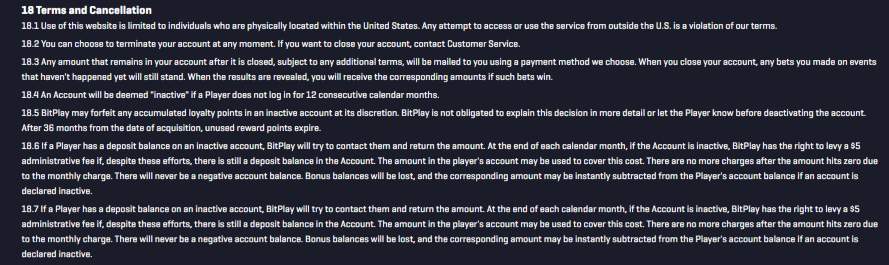
Source: Screenshot of BitPlay Terms and Cancellation section, showing U.S. access limits, account closure, inactivity rules, and fees. (Bitplay.ag)
Check 6: How do you fight back if something goes wrong?
If something goes wrong, and the contract gives you no way to challenge the operator’s decision, you have no leverage. That’s why I check the dispute resolution section for 5 things:
- A written complaints procedure.
- An arbitration clause (a legal process where a neutral party decides the dispute outside of court).
- A class action waiver (the line where you give up the right to sue as part of a group).
- An opt out window for arbitration, if you want to keep your right to sue in court.
- A stated governing law (the country whose courts apply if the dispute reaches a courtroom) you can actually reach.
✅ Good: SpeedSweeps
SpeedSweeps Casino writes the dispute process directly into its sweepstakes rules and ties it to actual abuse cases I might run into: offsetting bets in roulette or baccarat (betting on both sides at once to clear playthrough without risk), or running instant win games without genuinely intending to play.
I read that, and know exactly what counts as cheating, what happens if I get flagged, and how to push back if I disagree.

Source: Screenshot of SpeedSweeps terms on coin manipulation, bonus abuse, playthrough requirements, and redemption limits. (Speedsweeps.com)
❌ Bad: Mondo Sweeps
The dispute venue at Mondo Sweeps splits across two states, depending on which giveaway I entered. Win the daily cash prize, and I’m arguing in New York. Win the gift card promo, and I’m arguing in Texas.
Both go through the American Arbitration Association (AAA, the private body that handles most consumer arbitrations in the US), with class action waivers, but I won’t know which state applies until after a dispute starts, by which point I’ve already committed.
Filing fees, travel costs, and procedural rules differ between the two, so I’m signing up to dispute on terms I haven’t seen yet.
The winner notification clause makes it worse. “If Sponsor is unable to reach the potential winner within 7 days… those persons will become ineligible for the prize.” Miss the email for a week, and I forfeit a prize I already won. I’ve had legitimate prize emails sit in Spam for weeks before I noticed. This clause turns my Gmail filter into a forfeiture trigger.
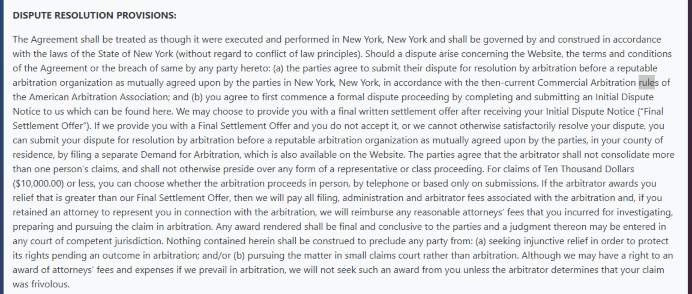
Source: Screenshot of MondoSweeps dispute resolution provisions, showing New York governing law, arbitration procedures, and class action limits. (Mondosweeps.com)
Check 7: What happens if you take a break or stop logging in?
Two scenarios put your balance at risk here, and the Dormancy Clause governs both. Stop logging in for too long, and the account closes with the balance forfeited. Take a self-exclusion break with money still pending, and the redemption may stop processing.
A 60 to 180 day inactivity window is the safe range, and anything shorter is aggressive. The other clause worth reading is what happens to a pending redemption if you take a break before they pay it out.
Remember the Galaxy Fortunes story from the opening? Section 13 was a discontinuation clause, which is a close cousin of the dormancy clause. Both forfeit balances when the player goes quiet. The only difference is whether the operator closes the site first or the player stops logging in first.
✅ Good: BangCoins
The inactivity policy at BangCoins Casino is published in defined numbers: unused SC expire after 60 days, the welcome bonus loses validity after 60 dormant days, and account closure follows extended dormancy beyond that.
Sixty days is shorter than I’d prefer for the SC expiry, but the policy is at least disclosed in numbers, rather than left to the operator’s discretion. I can plan around it by logging in once a month if I’m holding a balance.
Worth knowing for this check specifically: WW Funcrafters LLC is the Delaware company behind BangCoins, and the same operator runs SpeedSweeps, RichSweeps, SweepsRoyal, and DimeSweeps under identical sweepstakes rules.
A payout pattern across the sister sites is a reasonable indicator of how BangCoins enforces its own dormancy clause when a real balance reaches expiry.
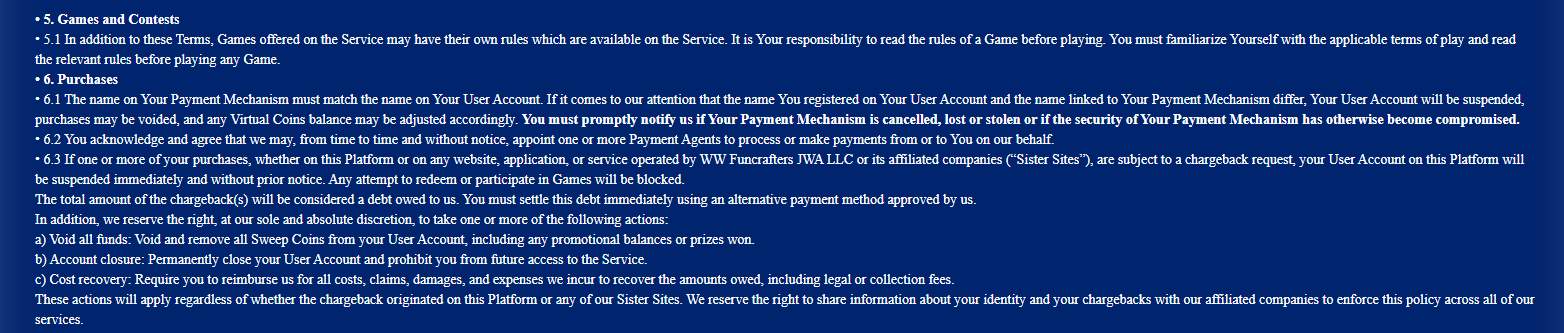
Source: Screenshot of BangCoins terms on games, purchases, payment matching, chargebacks, account suspension, and fund removal. (Bangcoins.com)
❌ Bad: Galaxy Fortunes
The contract anatomy behind the loss I opened with sits in Section 13 of Galaxy Fortunes’ Terms of Service. The closure refund splits into two categories: Game Tokens (the purchased currency) returned at face value, Sweeps Tokens (the redeemable currency) forfeited entirely.
It is that split that you need to look out for. Refunding only the cash side kept the operator legally defensible, while writing off the balances players had built through play, which were almost always larger than the cash side.
The clause wasn’t theoretical. It ran as written when the site closed, and the operator could correctly point to the document I’d ticked the acceptance box on.
The pattern to recognize on any new site: a discontinuation clause that distinguishes between purchased currency and earned currency, and refunds only the first one. Read every closure clause for that specific split before you start building a balance.
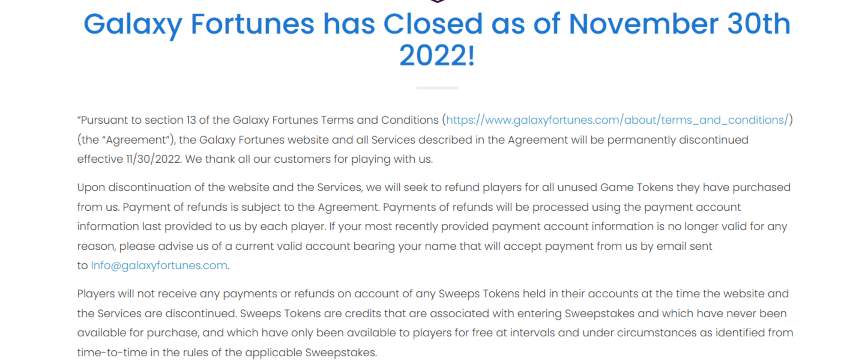
Source: Screenshot of Galaxy Fortunes closure notice, showing the shutdown date, refund process, and Sweeps Token refund exclusion. (Galaxyfortunes.com)
The 10-minute method
Now you know what to look for. Here’s how to find it fast.
Open the Terms of Service and the Sweepstakes Rules in two browser tabs. Hit Ctrl+F (Cmd+F on Mac) to open the search bar in each tab, and run the 8 keyword searches below in order.
Each search jumps you straight to the clause that answers one of the 7 checks above (Step 7 is a bonus search on contract changes that pairs with Check 5). The moment any one search comes back empty, I close the tab and move on.
| Step | Search for | Time | What you confirm |
| 1 | “registered,” “incorporated,” “Limited,” “Inc,” “LLC” | 60 to 90s | Company name, registration number, country, address |
| 2 | Your state name, “void where prohibited,” “excluded” | 45s | Whether your state appears on the excluded list |
| 3 | “redeem,” “minimum,” “playthrough,” “wagering” | 2 to 3 minutes | Cashout floor, playthrough, daily cap |
| 4 | “forfeit,” “void,” “suspend,” “sole discretion” | 90s | Triggers tied to defined behaviors, not vague language |
| 5 | “arbitration,” “class,” “dispute,” “governing law” | 60s | Stated process, opt out window, governing law |
| 6 | “inactive,” “dormant,” “expire” | 45s | Inactivity window of 60 to 180 days |
| 7 | “modify,” “amend,” “change” | 30s | Notice commitment if the operator changes the terms |
| 8 | “AMOE,” “mail,” “request code,” “postcard” | 60s | Working postal entry with address and SC payout |
Total time, roughly 10 minutes per site. I have walked away from at least four sites this year on Step 1 alone, and I have not regretted any of them.
Using AI to read the terms for you
Ten minutes per site is fine. If you want it down to one minute, hand the work to an AI. Paste the full text of the Terms of Service, the Sweepstakes Rules, and the Privacy Policy into an AI chat (ChatGPT, Claude, whichever you use) and run the 12 prompts below.
The AI does three things you can’t do as fast on your own. It reads every clause in seconds instead of minutes. It cross references Section 13 against Section 6 against Section 22 in the same pass, catching contradictions a manual skim would miss. And it pulls the exact wording out for you, so you can copy a quote into a Trustpilot complaint or a support email later, if you need to.
Why the prompts matter
The prompts are the entire game here. A vague prompt gets you a vague answer that paraphrases away the exact language you need. A precise prompt forces the AI to quote the contract directly and tell you the clause number it came from.
The difference between “Tell me about the dormancy policy” (useless) and “State the dormancy policy with clause numbers, and quote the exact language about pending redemptions during inactive periods” (useful) is the difference between a 60 second skim that protects you and a 60 second skim that lulls you into trusting a site you shouldn’t.
12 prompts that work
“Who is the legal operator? State the company name, registration number, country, and registered address as written in the document.”
A site that fails this fails Check 1, and I move on.
“List every US state excluded from the service, and state the minimum age requirement.”
Cross check against your residence and the ages stated for your state, since age requirements sometimes differ inside the same document.
“State the minimum SC cashout for cash, the minimum for gift cards, and any daily, weekly, or monthly caps, with the clause numbers.”
Clause numbers really matter because operators sometimes publish different numbers in marketing copy than in the contract. The contract version is the one that controls.
“State the playthrough requirement on free SC, on bonus SC, and on purchased SC, and note any difference.”
Free SC at 1x is normal. Anything substantially higher is unusual and worth a hard look.
“List every circumstance under which the operator can forfeit my balance, suspend my account, or close it. Quote the exact language for any clause that uses the phrase ‘sole discretion’.”
Reading the literal sentence catches the Bitplay style “AI usage” clause that a summary level prompt would paraphrase away.
“Describe the identity verification process. What documents are accepted? At what stage does it trigger? What happens if my verification is rejected?”
Most stuck redemption complaints on Trustpilot trace back to ID check failures, so the path to verification is the path to cashout. I wrote a separate piece on how to verify your identity at sweepstakes casinos covering which documents work and which get rejected.
“State the dormancy policy. How many days until SC expire? How many days until the account closes? What happens to pending redemptions during the inactive period?”
This is the Galaxy Fortunes question, and it’s the prompt I run hardest.
“Describe the dispute resolution process, the arbitration clause, the class action waiver, and any opt out window with its deadline and method.”
Note the deadline and the method. The opt out is usually a written notice posted to a specific address within 30 days of opening the account. Miss it and you give up your right to sue.
“State what happens to my SC and pending redemptions if I self exclude, take a break, or close the account voluntarily.”
Operator specific, and Galaxy Fortunes is the case study for what happens when the operator reads its own clause against you rather than for you.
“State what happens to my balance if the operator changes the terms, exits my state, or shuts down the service.”
Increasingly important in 2026 as the regulatory map keeps shifting state by state.
“List any clauses that would surprise an average player or differ from typical US sweepstakes casino practice.”
A general sweep that catches buried language the targeted prompts miss.
“On a scale of 1 to 10, rate how player friendly this term’s document is compared to standard US sweepstakes practice in 2026, and cite specific clauses with numbers.”
Forces the AI to compare and cite, which exposes a document that scans well but contains specific player hostile clauses on closer reading.
3 prompts that do not work
❌ “Summarize this document”
- Returns a generic overview that paraphrases the clauses that actually matter.
- AI is trained to compress text. Compression is the enemy here.
- A forfeiture clause or dormancy trigger gets smoothed into bland safe language that hides what the contract actually says.
❌ “Is this site legit”
- The document alone cannot answer this.
- Legitimacy depends on operator behavior: do they actually pay out, honor the AMOE, process disputes?
- That lives in player reviews and regulator records, not in the terms. The terms only tell you what the operator promised, not what the operator does.
❌ “Should I sign up”
- Pushes the AI toward a recommendation the document was never going to support.
- Triggers hedging, pros and cons lists, and a pretend financial recommendation the AI isn’t qualified to give.
- Ignore this prompt entirely.
The 30-second version
If you skip everything else in this guide, run this sequence on every new site before you sign up.
Open the Terms of Service and the Sweepstakes Rules. Find the operator name and country in the first paragraph (Check 1). Search your state in the restricted list (Check 2). Confirm the cashout minimum and the playthrough multiplier are real numbers (Checks 3 and 4). Read the forfeiture clause for defined triggers (Check 5). Confirm a dispute process and a dormancy window (Checks 6 and 7). Walk away the moment any one comes back empty.
The 7 good sites in this guide pass every check. The 7 bad ones each fail one specific test:
- The operator is hidden at VBlink.
- The state list is hidden at Panda Master.
- The redeemable currency is gated behind a purchase at Acereveal.
- There are no terms at all at Fire Kirin.
- Your balance can be wiped for using AI, or for going inactive at Bitplay.
- The dispute forum is split between two states at Mondo Sweeps, and your spam folder counts as a forfeiture trigger.
- Section 13 ran exactly as written at Galaxy Fortunes, the day the site closed.
Each one of those failures has cost players I’ve talked to real money. Learn the warning signs once, and you’ll spot the same tricks on any new site in under a minute. A lesson I wish someone had handed me before I lost $400 to Galaxy Fortunes in 2022.