Michael Selig: From Willkie Farr Partner to Sole CFTC Commissioner
Michael S. Selig spent close to a decade in private practice representing crypto and derivatives clients, including eToro and Paradigm. In December 2025, he became the 16th Chairman of the Commodity Futures Trading Commission (CFTC), the agency that regulates those same industries.
Six months in, he has sued nine state governments on behalf of the prediction market industry. The most recent suit, filed Tuesday, June 23, 2026, targets Kentucky and makes it the first state with a Republican attorney general to face the agency in court.

Content Manager
Last updated
26 June 2026

Key takeaways
- Michael S. Selig is the 16th CFTC Chairman, sworn in on December 22, 2025. Six months in, he runs the agency alone as its only sitting Commissioner, after Acting Chair Caroline Pham left for crypto firm MoonPay, where she now serves as Chief Legal Officer and Chief Administrative Officer.
- His career runs through both sides of the regulator. Selig clerked at the CFTC under Commissioner J. Christopher Giancarlo in 2014 and 2015, then spent close to a decade in private practice, and finished as a partner at Willkie Farr & Gallagher, representing crypto and derivatives clients, including eToro and Paradigm, before becoming chief counsel of the Securities and Exchange Commission’s (SEC) Crypto Task Force under Chairman Paul S. Atkins.
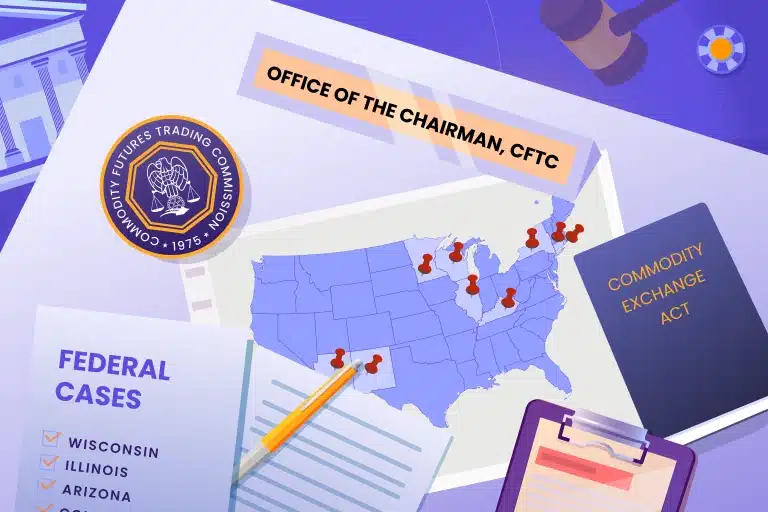
- Selig has sued nine state governments in under three months. The targets are Wisconsin, Illinois, Arizona, Connecticut, New York, New Mexico, Minnesota, Rhode Island, and Kentucky. The Kentucky filing on June 23, 2026, is the first against a state with a Republican attorney general.
- He is now also a personal prosecutor. CME Group named Selig in a lawsuit filed June 18, 2026, challenging the CFTC’s May 29 approval of Kalshi’s bitcoin perpetual futures contract. CME argues the product should be classified as a swap under the Dodd–Frank Act, rather than as a futures contract.
- The federal pathway for sweepstakes operators rests on the same legal theory. If Selig prevails on federal preemption, the CFTC registration route taken by ProphetX becomes a viable way out of state-by-state enforcement. If he loses, the protection is much weaker.
The lawyer-turned-regulator
Selig built his career inside the regulator he now runs. He earned his undergraduate degree from Florida State University and his law degree from The George Washington University Law School, where he served as articles editor of The George Washington Law Review.
He started at the CFTC in 2014 as a law clerk to Commissioner J. Christopher Giancarlo. Giancarlo would later become CFTC Chairman under the first Trump administration and, after leaving government, take over as Chair of Polymarket’s advisory board.
After the clerkship, Selig moved to private practice, spending close to a decade in commodities and derivatives law, and finishing as a partner at Willkie Farr & Gallagher from 2022 to 2025. His clients included roster crypto and derivatives firms such as eToro and Paradigm.
In early 2025, he moved back into government, becoming chief counsel of the SEC’s Crypto Task Force and a senior adviser to SEC Chairman Paul S. Atkins. He also participated in the President’s Working Group on Digital Asset Markets and contributed to its report, “Strengthening American Leadership in Digital Financial Technology.”
President Trump nominated him for the CFTC chairmanship on October 27, 2025, a month after the White House withdrew an earlier nomination of Brian Quintenz, a former CFTC commissioner, for the same role. That nomination unraveled after Gemini co-founders Cameron and Tyler Winklevoss raised conflict-of-interest concerns. The Senate confirmed Selig 53-43 on December 18, 2025, and he was sworn in as the 16th CFTC Chairman on December 22, 2025.
Why he sued Kentucky
The Kentucky filing followed two state actions taken six days earlier. On June 17, Kentucky Attorney General Russell Coleman filed separate lawsuits in Franklin Circuit Court against Kalshi, Polymarket, and sweepstakes operator VGW Holdings, alleging each was conducting unlicensed gambling in the state. The Kalshi complaint also named Coinbase Financial Markets, Robinhood Markets, Robinhood Derivatives, and Webull as co-defendants. Coleman dismissed the platforms’ legal structuring at the time, saying, “These multi-billion dollar corporations and their legal fictions don’t pass the sniff test.”
But the lawsuits were only part of the trigger. The same week, Kentucky’s new excise tax on prediction markets came into the picture: House Bill 757, passed by the General Assembly in April after legislation overrode Democratic Governor Andy Beshear’s veto, imposes a 14.25% tax on prediction-market transaction fees, mirroring the rate applied to online sportsbooks, set to take effect January 1, 2027. The CFTC’s complaint calls it the first state tax of its kind targeting prediction markets and argues, invoking Chief Justice John Marshall’s line from McCulloch v. Maryland, that “the power to tax involves the power to destroy,” that the tax is designed to make continued operation in the state economically impossible.
Selig’s federal countersuit landed on Tuesday, June 23, in the US District Court for the Eastern District of Kentucky. The defendants include Kentucky Governor Andy Beshear, Coleman himself, Department of Revenue Commissioner Thomas Miller, and the Kentucky Horse Racing and Gaming Corporation. The CFTC is asking the court for declaratory and injunctive relief, blocking both the state lawsuits and the new tax.
Selig framed the action as a defense of federal jurisdiction. “Kentucky is the latest state attempting to shut down federally-regulated energy contracts,” he said in the CFTC’s statement announcing the suit. “Prediction provides Kentuckians with valuable market information about the likelihood of future events and offers risk management products relied on by Kentucky businesses and individuals. As I’ve consistently pledged, the CFTC is firmly committed to maintaining its exclusive jurisdiction over prediction markets, and today’s lawsuit against Kentucky is yet another example of the Commission protecting its federal interests.”
Coleman is not backing down. He has pledged to defend Kentucky’s gambling laws against out-of-state companies, saying “You can bet our Office will defend these statutes and the people of our Commonwealth from out-of-state companies that seek to cancel Kentucky’s sports betting laws,” and adding that his office is “the odds-on favorite to win” in any courtroom.
The preemption theory
Selig’s case against the states rests on federal preemption. The CFTC argues that the Commodity Exchange Act gives the agency exclusive jurisdiction over swaps and futures contracts traded on Designated Contract Markets (DCMs), and that any state law attempting to regulate those contracts is preempted by federal law.
In the Kentucky complaint, the agency frames Kalshi’s and Polymarket’s event contracts as swaps traded on federally licensed DCMs, arguing they fall under the Commodity Exchange Act rather than state gambling law. The complaint also covers Coinbase, Robinhood, and Webull, arguing they are CFTC-registered futures commission merchants entitled to offer event contracts in partnership with a designated contract market.
That theory has had a mixed reception in the courts so far. On April 6, 2026, a divided panel of the US Court of Appeals for the Third Circuit became the first federal appellate court to rule on the issue, holding 2-1 in KalshiEX LLC v. Flaherty that Kalshi’s sports-related event contracts are swaps under the Commodity Exchange Act and that the Act preempts New Jersey’s gambling laws as applied to them, affirming a lower court’s injunction against the state. Days earlier, on April 2, the CFTC had separately sued Arizona, Connecticut, and Illinois on the same theory.
The Ninth Circuit has been less receptive. A three-judge panel heard consolidated arguments on April 16, 2026, in cases brought by Kalshi, Robinhood, and Crypto.com against the Nevada Gaming Control Board, appealing from a district court that had ruled against all three platforms and found that sports event contracts are not swaps, a position directly at odds with the Third Circuit’s.
Not all former regulators agree with Selig’s reading, either. On June 11, 2026, former CFTC and SEC Chair Gary Gensler filed an amicus brief with the Sixth Circuit in KalshiEX LLC v. Schuler , a case in which Kalshi is seeking to block Ohio from enforcing its gambling laws, arguing that sports-event prediction markets are not swaps under Dodd–Frank and siding with the state. Gensler, who led the CFTC’s implementation of Dodd-Frank from 2009 to 2014 and helped draft its swap provisions, wrote that reading the swap definition to cover sports bets would imply that every off-exchange sports wager placed since 2012 has been illegal, a result he says Congress never intended. The brief puts him squarely at odds with the agency he once chaired: The CFTC had filed its own amicus brief in the same case on May 12, asserting exclusive federal jurisdiction. Oral argument before the Sixth Circuit is scheduled for July 30.
Nine states in three months
Kentucky is the ninth state Selig’s CFTC has sued. The previous eight, Wisconsin, Illinois, Arizona, Connecticut, New York, New Mexico, Minnesota, and Rhode Island, were all sued beginning April 2, 2026, meaning the agency has filed nine federal suits against states in under three months.
The pace has accelerated. The CFTC filed against New Mexico on June 12, and against Kentucky eleven days later. The agency has also filed amicus briefs in pending cases before the Third, Sixth, and Ninth Circuit Courts of Appeal.
Kentucky is also the first state with a Republican attorney general to be sued by the agency; the previous eight all had Democratic AGs. That split had been a talking point for critics, including Wisconsin Attorney General Josh Kaul, who called the campaign “this federal power grab that seeks to limit the ability of states to protect their residents.” The Kentucky filing complicates that criticism, since Coleman is a Republican and a former Trump-appointed US Attorney.
Trump himself has publicly backed the CFTC’s stance. In a Truth Social post on May 26, 2026, he wrote that it was “critically important that the CFTC’s exclusive authority over prediction markets is maintained” and that “we are setting ‘rules of the road’ that are the Gold Standard for the States,” while naming and criticizing several state officials, including former New Jersey Governor Chris Christie and the attorneys general of New York, Minnesota, and Illinois, who have pushed back against CFTC jurisdiction. His son, Donald Trump Jr., is a paid strategic advisor to Kalshi and also sits on Polymarket’s advisory board; Trump Jr. ‘s venture firm, 1789 Capital, made a reported eight-figure investment in Polymarket.
A commission of one
The CFTC is normally a five-person commission. Today, Selig is its only sitting commissioner. By the time he was confirmed, the other four seats had already emptied out over the course of 2025: Democrat Christy Goldsmith Romero and Republican Summer Mersinger left in May 2025, Democrat Kristin Johnson departed in September, and Caroline Pham, who had served as acting chair since January 2025, resigned the day Selig was sworn in. Pham has since moved to MoonPay, the crypto payments company, as Chief Legal Officer and Chief Administrative Officer; she had publicly disclosed the move months before her departure while continuing to serve as the agency’s sole commissioner.
The arrangement gives Selig unusual operational authority. Major rulemaking decisions, enforcement priorities, amicus brief filings, and litigation choices that would normally pass through a multi-commissioner process now run through one person.
He has used that authority broadly. Beyond the nine state lawsuits, the agency signed a new memorandum of understanding with the SEC on March 11, 2026, superseding a prior 2018 agreement. The MOU created a Joint Harmonization Initiative, co-led by officials at each agency, covering joint product definitions, modernized clearing and margin frameworks, coordinated examinations, and a shared regulatory approach to crypto assets. “By working together, we’ll eliminate duplicative, burdensome rules and close gaps in regulation for the benefit of all Americans, and usher in a Golden Age of American finance,” Selig said at the time.
Selig’s Director of Enforcement, David I. Miller, laid out the philosophy behind the broader approach in his first public remarks since taking the role , delivered at NYU School of Law on March 31, 2026. “The era of regulation by enforcement is over,” Miller said, outlining five enforcement priorities: insider trading (including in prediction markets), market manipulation, market abuse, retail fraud, and willful anti-money-laundering violations, while emphasizing that the Division would focus on policing fraud rather than setting policy through enforcement actions.
The lawsuit against him
Selig is also a personal defendant in a separate federal lawsuit. On June 18, 2026, CME Group, parent of the Chicago Mercantile Exchange and the largest US derivatives exchange operator, sued the CFTC and Selig personally in the US District Court for the District of Columbia.
The complaint challenges the CFTC’s May 29, 2026, approval of Kalshi’s bitcoin perpetual futures contract, along with a related CFTC policy statement that lets other exchanges self-certify similar crypto perpetual contracts as futures without prior Commission review. CME argues that perpetual futures, derivatives with no fixed expiration date, are swaps under the Dodd–Frank Act, a classification it says the CFTC itself had applied in past enforcement actions, and that the agency acted arbitrarily and capriciously in approving Kalshi’s contract as a future instead, a more favorable designation with better tax treatment. CME’s complaint also notes that the CFTC approved Kalshi’s application in a single day, compared with one prior CME product approval that took 1,834 days.
The CFTC rejected the suit. A spokesman accused CME of pursuing “lawfare” against the agency and the administration’s “pro-innovation agenda,” while Kalshi called the suit a function of “fear of competition” rather than legal merit. Selig has defended the approval publicly, writing that extreme leverage associated with perpetual contracts has historically been a feature of unregulated offshore venues rather than something inherent to the product, and that bringing the contracts onshore under CFTC oversight serves the agency’s “statutory obligation to promote responsible innovation.”
The federal pathway hangs on Selig
ProphetX’s CFTC approval opened a federal pathway for sweepstakes operators that rests on the same preemption theory Selig is now defending across his nine federal lawsuits against states. If Selig wins, sweepstakes operators considering a ProphetX-style transition gain a meaningful legal shield against state-level enforcement.
If Selig loses, the federal pathway protects only against the federal regulator’s own priorities, not against state attorneys general. Coleman’s office is positioned to test that proposition directly. Other state AGs are watching.
Kalshi’s multibillion-dollar sports-related trading volume in 2025 is the kind of business that depends on Selig’s argument holding up in court. The outcome for sweepstakes operators turns on the same legal question.
The next six months
The federal preemption argument is being litigated in nine federal district court cases in which Selig’s CFTC is the plaintiff against state defendants. The same question runs through Kalshi’s and Polymarket’s own federal suits against state regulators, and at least three federal appellate courts, the Third, Sixth, and Ninth Circuits, are weighing in, with the split between the Third Circuit’s pro-preemption ruling and the pending Sixth and Ninth Circuit cases raising the likelihood of eventual Supreme Court review.
The CME suit puts the agency on defense in DC federal court, with the case turning on whether the CFTC adequately justified reversing its earlier position that perpetual contracts are swaps.
Congress is the third front. The CLARITY Act, digital asset market structure legislation the administration has been pushing, would convert much of Selig’s current regulatory framework into statute. For now, Selig’s agency-led approach rests on agency interpretation rather than law, meaning a future administration could reverse course if Congress doesn’t act first.
For now, the agency is running on one commissioner. The lawsuits are stacking up. The man at the center of all of it is six months into a five-year term.
Sources
Primary
- CFTC, CFTC Sues Kentucky to Prevent Violation of CFTC’s Exclusive Jurisdiction, press release, June 23, 2026, via cftc.gov.
- CFTC, Michael Selig Sworn In as 16th CFTC Chairman, press release, December 22, 2025, via cftc.gov.
- The Hill, CFTC sues Kentucky over predicting market lawsuits, June 23, 2026.
- CNBC, CFTC sues Kentucky over actions against prediction markets, June 23, 2026.
- The Crypto Times, CFTC Sues Kentucky Over 14.25% Tax, Marking 9th State Prediction Market War ,June 24, 2026.
- Reuters, CME sues US CFTC over letting Kalshi, Coinbase offer perpetual futures, June 18, 2026.
- The Defiant, Gensler Files Brief Arguing Sports Prediction Markets Fall Outside CFTC Swap Rules, June 12, 2026.
- CoinDesk, Former SEC, CFTC Chair Gary Gensler Argues That Prediction Markets Don’t Overrule State Regulations, June 12, 2026.
Statutes, regulations, and remarks
- CFTC, Remarks by Director of Enforcement David I. Miller at NYU School of Law, March 31, 2026.
- SEC, SEC and CFTC Announce Historic Memorandum of Understanding Between Agencies, March 11, 2026.
- CFTC, Commodity Exchange Act & Regulations, statutory framework underlying the CFTC’s preemption theory.
- SEC, Crypto Task Force, background on Selig’s prior role as chief counsel.
- The White House, Strengthening American Leadership in Digital Financial Technology, President’s Working Group on Digital Asset Markets report, July 2025.
- US House Committee on Agriculture, Testimony of Michael Selig, April 16, 2026.
Nomination and personnel
- The Hill, Trump nominates Mike Selig for CFTC head, October 25, 2025.
- The Hill, Trump: ‘Critically important’ CFTC has exclusive authority over prediction markets, May 27, 2026.
- Reuters, Polymarket secures investment from Trump Jr-backed 1789 Capital, August 26, 2025.
- MoonPay, Newsroom: Caroline D. Pham, announcement of Pham’s appointment as Chief Legal Officer and Chief Administrative Officer.
Litigation and legal analysis
- Lexology, CFTC and the prediction markets jurisdiction fight.
- CFTC, CFTC Seeks Public Comment on Advance Notice of Proposed Rulemaking Relating to Prediction Markets.
Industry context
- SweepCasinos, “Kentucky Sues VGW, Kalshi and Polymarket in a Single Day,” June 22, 2026, coverage of the June 17 Kentucky state enforcement actions that triggered the CFTC’s federal response.
- SweepCasinos, “Kalshi’s $22 Billion Sweepstakes Reprieve,” analysis of Kalshi’s 2025 sports-related trading volume and its implications for sweepstakes operators.
- SweepCasinos, “ProphetX CFTC Approval,” June 16, 2026, coverage of ProphetX becoming the first sweepstakes-model operator to receive CFTC approval as both a Designated Contract Market (DCM) and a Derivatives Clearing Organization (DCO).