The Slow Death of Credit-Funded Gambling in the U.S.
It was on August 25, 2025, that DraftKings officially eliminated all its players’ options to deposit via credit card on all its U.S. sportsbook and online casino platforms simultaneously.

Content Writer
Last updated
18 June 2026


DraftKings Moved First in August 2025
While this decision may not seem earth-shattering in itself, the fact that a payment channel that had long been the absolute payment standard now was removed, does call the very same standard itself into question.
That said, the very same standard had already begun to be called into question by state lawmakers and gaming commissions throughout 2024, stretching into 2025. And it was exactly that pressure that led DraftKings to react how it reacted. And not just because it was casually deciding it was time for a new payment direction. It was a calculated response to a more challenging regulatory environment that started with a Senate Banking Committee Letter, all happening in a broader context in which it has become more and more difficult to justify borrowing money for funding bets in the name of consumer protection.
And when DraftKings made its move on August 25, the company and other real money operators that still processed credit cards in permitted jurisdictions had already been operating across different state rulebooks for several months.
By early 2025, Massachusetts, Iowa, Tennessee, and Vermont had already prohibited the use of credit cards for regulated sports betting deposits. Meaning in those four states, processing credit card deposits for regulated sports betting via Mastercard, Visa, and others, would have violated state law anyway.
Once those four states enacted their legal framework, practically all operators active in those states had to block the credit method locally while keeping it available in the rest of the country. This meant that, before August 25, the map was already split.
Now, FanDuel Tightens Card Controls Too
DraftKings isn’t the only big name tinkering with its payment setup by removing credit cards as a payment option. FanDuel, a top real-money sportsbook and online casino in the U.S. in terms of market share and user base, is also making changes.
As of March 2, 2026, FanDuel will no longer accept U.S. credit card deposits on its Sportsbook, Casino, and Racing platforms. This includes credit cards tied to services like Venmo, PayPal, and Apple Pay.
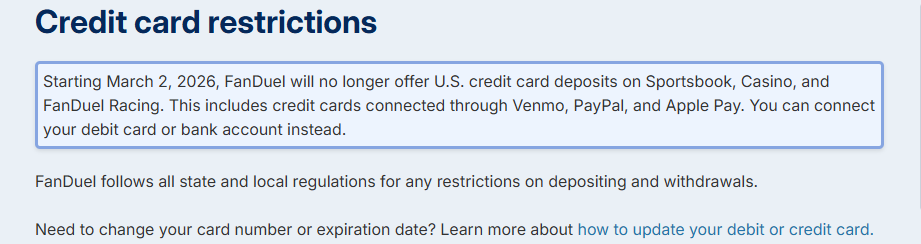
Source: https://support.fanduel.com/s/article/Credit-card-restrictions?
Will This “Trend” Spill Over Into Sweepstakes Casinos?
The most obvious question now is whether this tightening of credit-funded betting will come to an end at regulated sportsbooks and real-money gambling platforms. Or if it sees itself spread to other online gaming models, with the most notorious one obviously being the sweepstakes casino model, which shot to fame and glory within the last decade.
Because, in the end, we know that sweepstakes casinos have very cleverly built a regulatory gray corridor for themselves, allowing them to operate while avoiding strict online gambling laws. And all they did was base their model on a two-currency system, in which Gold Coins are purchased for gameplay, and Sweepstakes Coins are distributed as promotional entries. The genius behind it: They claim that, because no real money is wagered, real money gaming laws cannot be applied.
However, this regulatory loophole is being questioned as time continues to move forward, with state laws tightening as we speak. By 2026, several U.S. states have already banned these types of gaming sites, and others are in the process of debating it.
Yet, there remains a lot of uncertainty within that entire debate, and not only for states that haven’t made any legislative moves yet. Because even states that previously seemed settled on that matter are now showing signs of becoming less black-and-white.
The state of California is the best example. Tribal gaming stakeholders have suddenly started showing a lot of interest in the niche (visible in this recent industry briefing on closing California loopholes), which has pulled sweepstakes platforms back into the spotlight. Ultimately, this has raised the broader question of whether this model will be permitted in the state long term.
So, returning to our original question of whether sweepstakes or social casinos could be the next target of restrictions on credit-funded betting, state lawmakers must first answer the basic issue that remains unresolved in parts of the country before this gaming niche can be debated. And that is whether this model even stands as it is structured, or rather, how to legally structure it in the first place.
Sources
- California Senate Committee on Public Safety. (2025). AB 831: Prohibited gambling—online sweepstakes games.
- FanDuel. (2026). Credit card restrictions. FanDuel Support.
- Iowa Legislature. (2025). Iowa Code § 99F.9(6): Wagering— restrictions.
- Massachusetts Legislature. (n.d.). Massachusetts General Laws Part I, Title II, Chapter 23N, Section 13.
- Sports Gaming Accounts. Tenn. Comp. R. & Regs. 1350-01-.08 (2023).
- United States Senate Committee on Banking, Housing, and Urban Affairs. (2026, February 6). Ahead of Super Bowl, Warren warns of credit card junk fees on sports bets and requests data from sports betting companies.
- Vermont Legislature. (2023). Act 63: An act relating to sports wagering.